



HPLC and FPLC Buffers Overview
High performance liquid chromatography (HPLC) and fast protein liquid chromatography (FPLC) are widely used separation techniques in biological research, bioprocessing, and analytical workflows. While the instrumentation and applications differ, both techniques rely heavily on precisely formulated buffers to achieve reproducible, high-resolution separations.
This overview focuses on how HPLC and FPLC buffers are used, what properties matter most, and how to select the appropriate buffer system for your application.
On this page:
-
What are HPLC and FPLC buffers?
-
What is the difference between HPLC and FPLC?
-
How do HPLC and FPLC buffers work in chromatography?
-
Common components of HPLC and FPLC buffers
-
Choosing the right buffer for your application
-
Troubleshooting common HPLC/FPLC buffer issues
-
Frequently Asked Questions (FAQs)
What are HPLC and FPLC buffers?
HPLC and FPLC buffers are mobile phase solutions used to transport samples through a chromatography column while maintaining pH, ionic strength, and protein or analyte stability.
These buffers are designed to:
- Maintain consistent pH throughout a run
- Preserve protein structure and activity
- Enable controlled interactions between the sample and stationary phase
- Minimize background noise and signal variability
In liquid chromatography, the buffer serves as the mobile phase that carries analytes through the column and directly influences separation efficiency.
What is the difference between HPLC and FPLC?
While both techniques use liquid chromatography principles, they are optimized for different applications.
HPLC
- Typically used for small molecules and peptides
- Operates at higher pressures
- Commonly coupled with detectors such as UV or mass spectrometry (MS)
- Requires highly filtered, low-particulate buffers
FPLC
- Designed for protein purification and biomolecules
- Operates at lower pressures
- Compatible with sensitive proteins and enzymatic activity
- Buffers often emphasize protein stability and mild conditions
Understanding these differences helps guide buffer selection and preparation.
How do HPLC and FPLC buffers work in chromatography?
HPLC and FPLC buffers influence separations through several key parameters:
- pH: Affects charge state and binding behavior of analytes
- Ionic strength: Controls electrostatic interactions
- Additives: Improve solubility, stability, or resolution
- Gradient composition: Enables selective elution
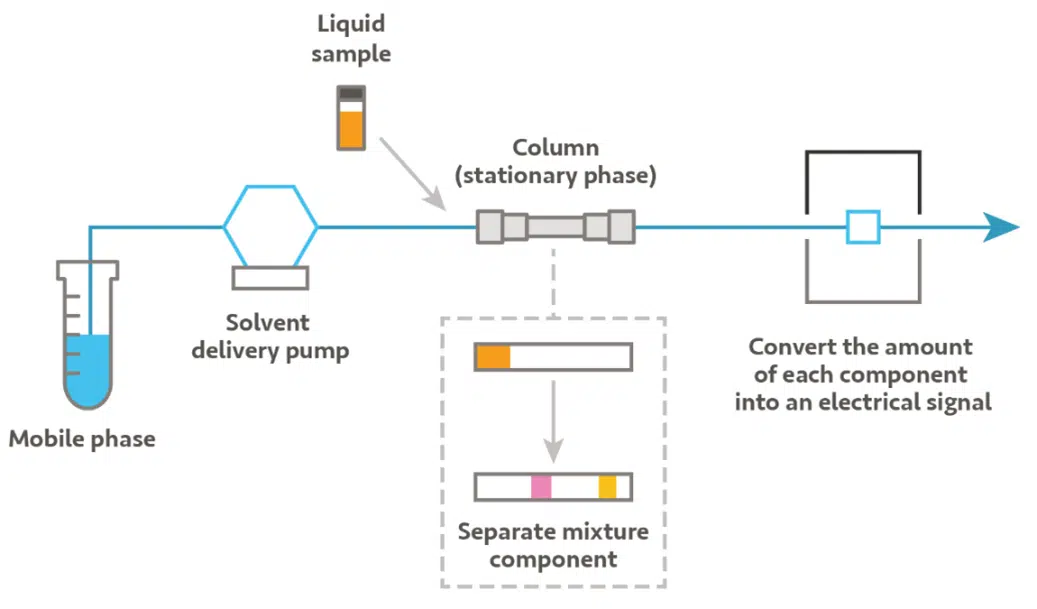
As illustrated in the HPLC system diagram, the buffer flows from the reservoir through the pump, column, and detector, directly impacting retention time and resolution.
Common components of HPLC and FPLC buffers
HPLC & FPLC are both very prevalent liquid chromatography techniques in biological sciences and each support several application types. Such application types of HPLC & FPLC and include:
| Component | Function |
|---|---|
| Buffering agents (e.g., HEPES, Tris) | Maintain stable pH |
| Salts | Control ionic strength |
| Organic modifiers | Improve solubility and separation |
| Additives | Enhance stability or reduce non-specific interactions |
| Buffer | Description |
|---|---|
| Ammonium Bicarbonate Buffer | A weak base buffer with a pKa of 6.4, suitable for neutral to slightly alkaline pH applications and for separating basic analytes. It can be used with polymer columns. It is also compatible with MS detection. |
| Acetate Buffer | A weak acid buffer with a pKa of 4.7, suitable for low pH applications and for separating acidic analytes. It can be used with both silica and polymer columns. |
| Bis-Tris Propane Buffer | A zwitterionic buffer with a pKa around 6.8, ideal for biological and biochemical applications. Known for its stability and minimal interference with biological processes. |
| Borate Buffer | A buffer containing boric acid and its conjugate base, suitable for electrophoresis and enzymatic reactions. Borate buffers are often used in the separation of negatively charged molecules. |
| Citrate Buffer | A weak acid buffer with a pKa around 3.1, commonly used in molecular biology and biochemistry. It is effective for antigen retrieval in immunohistochemistry and as a buffering agent in enzymatic reactions. |
| Formate Buffer | A weak acid buffer with a pKa of 3.8, suitable for low pH applications and for separating acidic analytes. It can be used with both silica and polymer columns. It is also compatible with mass spectrometry (MS) detection. |
| HEPES Buffer | A zwitterionic buffer with a pKa of approximately 7.5 that ensures stable pH conditions during chromatographic separations, enhancing precision in bioanalytical and pharmaceutical applications. |
| MOPS Buffer | A zwitterionic buffer with a pKa around 7.2, MOPS Buffer excels in delivering constant pH levels, optimizing separation, and resolution in chromatographic processes. It provides stable pH conditions and is suitable for various biological experiments. |
| Phosphate Buffer | A weak base buffer with a pKa of 7.2, suitable for neutral to slightly alkaline pH applications and for separating basic analytes. It can be used with both silica and polymer columns. |
| Triethylammonium Acetate Buffers | A volatile buffer suitable for high-performance liquid chromatography (HPLC) and mass spectrometry. Used for the separation of various analytes, particularly in the field of proteomics. |
| Triethylammonium Bicarbonate Buffers | A buffer often employed in protein chemistry and mass spectrometry, with a pKa around 8.4. It is volatile and compatible with downstream analyses. |
| Triethylammonium Phosphate Buffers | A buffer suitable for ion-exchange chromatography and protein purification. It is particularly useful for applications involving proteins and peptides. |
| Tris Buffer | A weak base buffer with a pKa of 8.1, suitable for alkaline pH applications and for separating proteins and nucleic acids. It can be used with polymer columns. |
How do I choose the right HPLC or FPLC buffer?
Selecting the appropriate buffer depends on several factors:
Application type
- Analytical vs. preparative workflows
- Protein purification vs. small molecule analysis
Detection method
- UV detection
- Mass spectrometry compatibility
- Fluorescence-based detection
Sample properties
- Protein stability requirements
- Sensitivity to pH or salt concentration
Buffers should be chosen to support both the chromatography method and downstream analysis.
Troubleshooting common HPLC and FPLC buffer issues
High backpressure
- Buffer may contain particulates
- Inadequate filtration or degassing
Poor resolution
- Incorrect pH or ionic strength
- Incompatible buffer additives
Protein precipitation
- Buffer conditions too harsh
- Sudden pH or salt changes
Signal instability
- Buffer incompatibility with detector
- Inconsistent buffer preparation
Careful buffer preparation and validation can prevent many common chromatography issues.
HPLC/FPLC buffers vs. other laboratory buffers
Unlike general laboratory buffers, HPLC and FPLC buffers must meet stricter requirements for:
- Purity
- Filtration
- Reproducibility
- Detector compatibility
Using non-optimized buffers can compromise column performance and data quality.
Frequently asked questions about HPLC and FPLC buffers
HPLC/FPLC Buffers at Boston BioProducts
Every HPLC and FPLC buffer is unique to the analyte used and the experimental application. Select the appropriate HPLC or FPLC Buffer from the catalog or design your optimal formulation with custom manufacturing options at Boston BioProducts.
References:
-
- Hamilton, R. J., & Sewell, P. A. (1982). Introduction to high performance liquid chromatography. Springer.
- Madadlou, A., O’Sullivan, S., & Sheehan, D. (2016). Fast protein liquid chromatography. In R. J. Beynon & J. S. Bond (Eds.), Protein chromatography: Principles and practice(pp. 327-338). Springer.