



Overview: Metal Salt Solutions
Metal salt solutions are ionic formulations containing precise concentrations of metal cations (Na⁺, K⁺, Ca²⁺, Mg²⁺ and others) paired with counter-anions in aqueous solution. These solutions regulate essential physical and biological parameters such as osmolality, conductivity, ionic strength, and sometimes pH, all of which are critical for consistent performance in cell culture, protein studies, enzyme assays, analytical workflows, and bioprocessing.
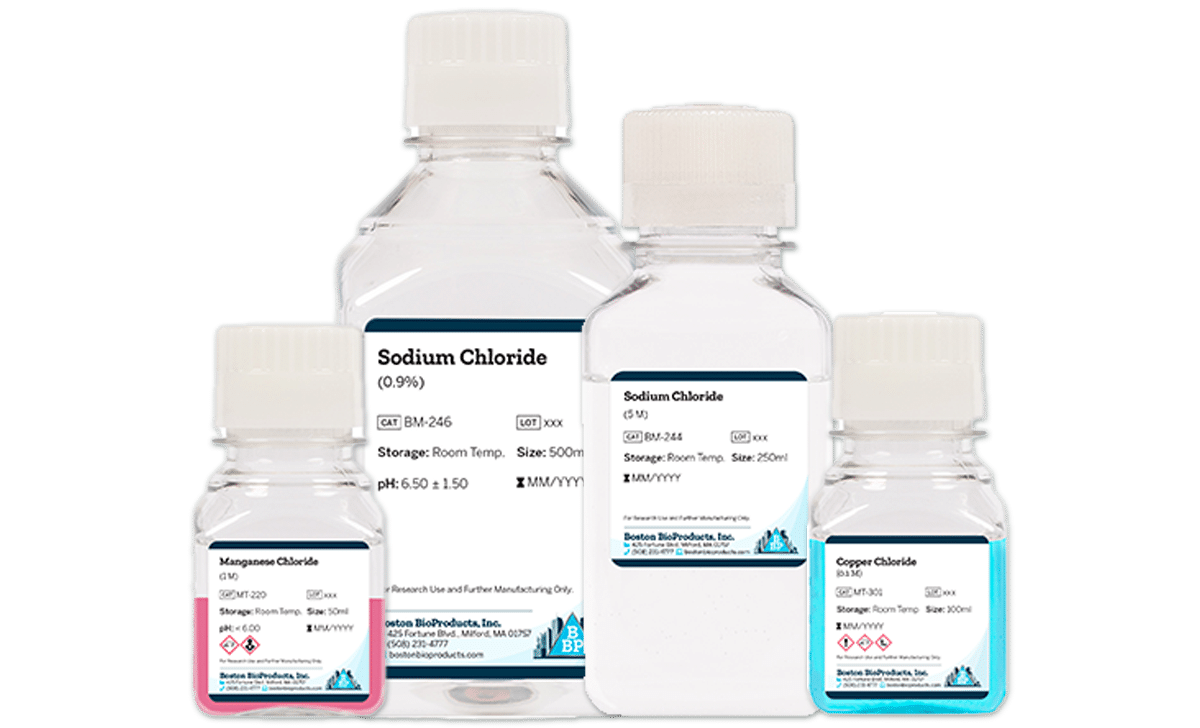
Metal salt solutions are used to mimic physiological ionic conditions, supply enzyme cofactors, stabilize biomolecules, and tune ionic strength for separation or detection methods. Boston BioProducts offers a range of ready-to-use and custom-manufactured metal salt solutions for reproducible workflows.
What Are Metal Salt Solutions?
Metal salt solutions are aqueous formulations where metal ions dissolve as positively charged cations paired with appropriate anions (e.g., chloride, sulfate). These ions disperse uniformly throughout the solution, allowing precise control of ionic composition.
They may be designed to:
- Mimic physiological ionic balance
- Support osmotic stability in cell culture
- Provide enzyme cofactors
- Adjust conductivity for chromatography and electrophoresis
- Regulate ionic strength for binding, detection, or stability
How Metal Salt Solutions Work
Once dissolved, metal salts ionize and influence key physicochemical properties:
- Osmotic balance: Na⁺ and K⁺ control extracellular vs. intracellular tonicity.
- Cofactor activity: Mg²⁺ and Mn²⁺ support ATP-dependent enzymes and polymerases.
- Protein structure & stability: Ca²⁺ can influence folding or bridging interactions.
- Conductivity & ionic strength: Critical for chromatography, electrophoresis, and analytical detection.
- Complex formation: Some metal ions interact with phosphates, carbonates, or biomolecules, affecting solubility and performance.
How to Choose the Right Metal Salt Solution
- Identify application context
Are you formulating a balanced salt solution, cell culture medium, enzyme assay system, chromatography buffer, or bioprocess feed?
Cell culture typically uses combinations of NaCl, KCl, CaCl₂, MgSO₄, and other physiological ions. - Define required ionic composition
- Ca²⁺ for cell adhesion or signaling
- Mg²⁺ for enzyme catalysis and ATP stabilization
- K⁺ for membrane potential and intracellular balance
- Evaluate solution properties
Consider effects on:- Osmolality
- Conductivity
- pH shift upon dissolution
- Interaction with other buffer components
- Check compatibility and risk
- Avoid salts that precipitate with phosphates (e.g., Ca²⁺ + PO₄³⁻)
- Confirm ion concentrations do not cause cytotoxicity
- Verify no interference with assay readouts or detection chemistries
Assess scale and manufacturing specs
For bioprocessing: confirm sterile filtration, certificates of analysis, lot reproducibility, packaging, and stability data.
Application Context & Key Use-Cases
| Use Case | Typical Metal Salt Composition | Important Considerations |
|---|---|---|
| Mammalian cell culture / balanced salt environment | NaCl, KCl, CaCl₂, MgSO₄ with optional trace metals | Maintain isotonicity; prevent precipitation with phosphates; align with physiological ion levels |
| Enzyme assay buffer or reaction system | Mg²⁺, Mn²⁺, Ca²⁺ as cofactors; Na⁺/K⁺ for ionic strength | Confirm metals do not inhibit enzymes or interfere with detection |
| Analytical / separation buffers (HPLC, FPLC, electrophoresis) | NaCl or KCl gradients; Mg²⁺/Ca²⁺ if needed for stability | Ensure solubility and compatibility with columns, detectors, and mobile phase components |
| Upstream/downstream bioprocessing | Large-volume NaCl or KCl; Mg²⁺/Ca²⁺ mixtures; trace metals | Sterility, scalability, lot reproducibility, and cost efficiency are critical |
Tips & Troubleshooting: Metal Salt Solutions
Tips
- Use sterile-filtered (0.22 μm) metal salt solutions for cell culture and aseptic workflows.
- Validate osmolality and conductivity after adding salts, especially in scaled production.
- Add multiple salts slowly and sequentially, checking for turbidity or precipitation.
- Avoid combining divalent ions (Ca²⁺, Mg²⁺) with phosphate buffers when possible.
- Store as directed (typically protected from light/moisture) to maintain purity.
For cell culture, match physiological targets (e.g., ~140 mM Na⁺, ~5 mM K⁺).
Troubleshooting
| Problem | Likely Cause | Solution |
|---|---|---|
| Precipitation after adding metal salt | Reduce concentration, adjust pH, change buffer system, or modify order of addition | Maintain isotonicity; prevent precipitation with phosphates; align with physiological ion levels |
| Unexpected osmolality or conductivity | Recalculate formulation; verify using calibrated instruments | Confirm metals do not inhibit enzymes or interfere with detection |
| Reduced cell viability after switching salt solution | Ionic strength too high or incorrect Ca²⁺/Mg²⁺ ratio | Compare against physiological ranges; run small pilot viability assays |
| Assay signal interference | Metal ions interacting with detection chemistry or analytes | Switch metal form, lower concentration, or test alternative ion combinations |
Frequently Asked Questions (FAQs)
Metal Salt Solutions at Boston BioProducts
Metal salt solutions are essential reagents for controlling ionic environments across biological and analytical workflows. Choosing the correct metal ions, validating composition, preventing precipitation, and aligning formulations with your application ensures reliable performance and reproducible results.
Explore Metal Salt Solutions at Boston BioProducts
Request Custom Metal Salt Formulations