


Overview: Phosphate Buffered Saline (PBS)
Phosphate Buffered Saline (PBS) is a widely used isotonic buffer solution designed to maintain stable pH and osmotic balance in biological systems. It plays a critical role in workflows such as cell culture, protein purification, and immunoassays by preserving cell integrity and biomolecular structure.
PBS is valued for its simplicity, reproducibility, and compatibility across a broad range of laboratory and bioprocessing applications.
On this page:
-
What Is Phosphate Buffered Saline (PBS)?
-
What Is PBS Made Of? (Composition Overview)
-
What Is Dulbecco’s PBS (DPBS)?
-
DPBS vs PBS: What’s the Difference?
-
Why Use PBS with Detergents?
-
Types of PBS Solutions & Selection Guide
-
Applications of PBS, DPBS and specialized PBS solutions
-
Tips & Troubleshooting
-
Frequently Asked Questions (FAQs)
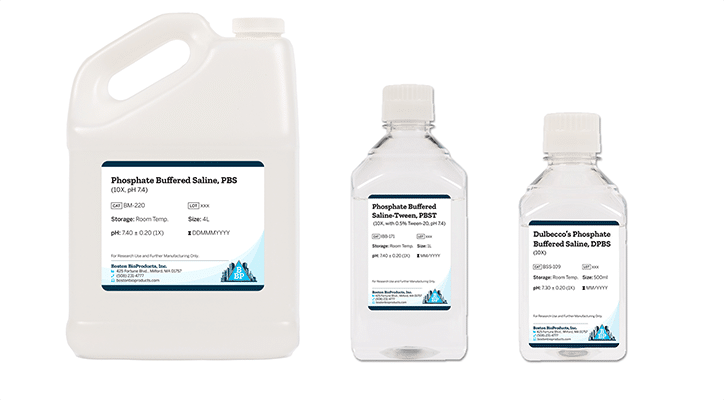
What Is Phosphate Buffered Saline (PBS)?
PBS is a water-based salt solution containing phosphate salts and sodium chloride that maintains physiological pH (typically 7.0–7.4) and isotonic conditions.
It is commonly used to:
- Maintain cell viability during handling
- Stabilize proteins and biomolecules
- Provide a consistent ionic environment for assays and workflows
What Is PBS Made Of? (Composition Overview)
Understanding phosphate buffered saline composition is essential for selecting the right formulation for your workflow.
Key Components
Phosphate Buffer System
- Potassium phosphate monobasic / sodium phosphate dibasic
- Maintains pH between 7.0–7.4
- At Boston BioProducts, PBS pH is typically adjusted using sodium hydroxide
- Potassium-based pH adjustment is available for potassium-sensitive workflows
Salts for Osmotic Balance
- Sodium chloride (NaCl)
- Potassium chloride (KCl)
- Maintain isotonicity and cellular stability
Specialized PBS Options
- RNase-Free PBS
Designed for RNA-sensitive workflows such as RNA isolation and transcriptomics
- Low Endotoxin PBS
Suitable for endotoxin-sensitive applications including cell therapy and immune assays
- Potassium-Free PBS
Used in workflows where potassium ions may interfere with biological processes
Key Features
- Non-toxic and cell-friendly for extended exposure
- Available in RNase-free and low-endotoxin formats
- Supports consistent experimental reproducibility
- Compatible with a wide range of biological workflows
| Buffer | Description |
|---|---|
| BM-220S | Phosphate Buffered Saline, PBS (pH 7.4, Sterile-Filtered) |
| BM-220X | Phosphate Buffered Saline, PBS (20X) |
| BM-221 | Phosphate Buffered Saline, PBS (10X, pH 7.6) |
| BM-220 | Phosphate Buffered Saline, PBS (10X, pH 7.4) |
| BM-222 | Phosphate Buffered Saline, PBS (10X, for Western Blot Washing) |
| BM-220S-LT | Phosphate Buffered Saline, PBS (Sterile-Filtered, Low Endotoxin) |
| BM-220-LT | Phosphate-Buffered Saline, PBS (10X, Low Endotoxin) |
| BM-220S-DR | Phosphate Buffered Saline, PBS (Sterile-Filtered, RNase Free) |
| BM-220-DR | Phosphate Buffered Saline, PBS (10X, RNase Free) |
| BB-125 | Phosphate Buffered Saline, PBS (10X without K, pH 7.4) |
What Is Dulbecco’s Phosphate Buffered Saline (DPBS)?
Dulbecco’s PBS (DPBS) is a modified PBS formulation designed for more specialized biological applications, particularly in cell culture.
Key Characteristics:
- Higher sodium phosphate content
- Reduced potassium phosphate concentration
- Optional inclusion of:
- Calcium (Ca²⁺)
- Magnesium (Mg²⁺)
These additions support:
- Cell adhesion
- Cell signaling
- Enzymatic activity
| Buffer | Description |
|---|---|
| BS-109 | Dulbecco's Phosphate Buffered Saline, DPBS (10X) |
| BS-105 | Dulbecco's Phosphate Buffered Saline, DPBS (with Metal Mix) |
| BS-100 | Dulbecco's Phosphate Buffered Saline, DPBS |
| BS-111 | Dulbecco's Phosphate Buffered Saline, DPBS (10X, with Metal Mix) |
| BPS-504 | 10X Dulbecco's Phosphate Buffered Saline, DPBS (no Calcium, no Magnesium) [BioProcess Grade] |
| BPS-503 | Dulbecco's Phosphate Buffered Saline, DPBS (no Calcium, no Magnesium) [BioProcess Grade] |
DPBS vs PBS: What’s the Difference?
| Feature | PBS | DPBS |
|---|---|---|
| Buffer system | Standard phosphate buffer | Modified phosphate system |
| Calcium & magnesium | Not included | Optional inclusion |
| Primary use | General lab workflows | Cell culture applications |
| Cell adhesion support | Limited | Enhanced |
| Enzyme compatibility | Neutral | Supports metal-dependent enzymes |
| Typical applications | Washing, dilution, immunoassays | Cell handling, tissue processing |
How to Choose Between PBS and DPBS
Use PBS when:
- Performing washing, dilution, or protein workflows
- Avoiding interference from divalent cations
Use DPBS when:
- Working with live or adherent cells
- Cell signaling or enzymatic activity is required
Why Use PBS with Detergents?
While standard PBS provides a stable, isotonic environment, some workflows require additional functionality such as reducing non-specific binding or disrupting cell membranes. In these cases, PBS is combined with detergents to enhance performance.
PBS with detergents is commonly used in immunoassays, protein workflows, and cell lysis applications, where controlling interactions at the molecular or membrane level is critical.
Common Types of PBS with Detergents
PBST (PBS + Tween-20)
PBST contains Tween-20, a mild, non-ionic detergent that reduces non-specific interactions.
Ideal for:
- ELISA washing steps
- Western blot washing
- Immunostaining workflows
Key benefit:
- Improves signal-to-noise ratio by minimizing background binding
PBS with Triton X-100
Triton X-100 is a stronger, non-ionic detergent used for membrane disruption and protein solubilization.
Ideal for:
- Cell lysis
- Protein extraction
- Membrane permeabilization
Key benefit:
- Efficiently disrupts lipid membranes to release intracellular components
Phosphate Buffered Saline-Tween (PBST)
Use PBST when:
- You need to reduce non-specific binding in assays
- Working with antibodies or detection systems
Use PBS + Triton X-100 when:
- You need cell lysis or membrane permeabilization
- Extracting intracellular proteins
Key Considerations
- Detergent concentration can affect assay sensitivity and protein stability
- Overuse of strong detergents may disrupt protein structure
- Always match detergent type to your application (washing vs lysis)
| Buffer | Description |
|---|---|
| IBB-171R | Phosphate Buffered Saline-Tween, PBST (with 0.05% Tween-20, pH 7.4) |
| IBB-170X | Phosphate Buffered Saline-Tween, PBST (20X, with 2% Tween-20, pH 7.4) |
| IBB-171X | Phosphate Buffered Saline-Tween, PBST (20X, with 1% Tween-20, pH 7.4) |
| IBB-170 | Phosphate Buffered Saline-Tween, PBST (10X, with 1% Tween-20, pH 7.4) |
| IBB-171 | Phosphate Buffered Saline-Tween, PBST (10X, with 0.5% Tween-20, pH 7.4) |
| BM-220T | Phosphate Buffered Saline, PBS (10X, with Triton X-100 |
Types of PBS Solutions & Selection Guide
| Solution Type | Key Components | Best For | Notes |
|---|---|---|---|
| Standard PBS | NaCl, phosphate buffer | General lab use | Baseline formulation |
| PBS (no potassium) | NaCl + sodium phosphate | Potassium-sensitive assays | Avoids K⁺ interference |
| RNase-Free PBS | RNase-free formulation | RNA workflows | Prevents RNA degradation |
| Low Endotoxin PBS | Reduced endotoxin levels | Cell therapy, immune assays | High purity requirement |
| DPBS (no Ca/Mg) | Modified PBS | General cell washing | Prevents unwanted signaling |
| DPBS (+ Ca/Mg) | Includes Ca²⁺, Mg²⁺ | Cell adhesion, signaling | Supports biological activity |
| PBST (PBS + Tween-20) | Non-ionic detergent | ELISA, Western blot | Reduces non-specific binding |
| PBS + Triton X-100 | Stronger detergent | Cell lysis, protein solubilization | More disruptive |
Applications of PBS, DPBS, and Specialized PBS Solutions
| Solution Type | Key Components | Best For | Notes |
|---|---|---|---|
| Protein purification | PBS | Phosphate buffer + NaCl/KCl | Maintains protein stability and native structure |
| Sample dilution & resuspension | PBS | Isotonic salt solution | Preserves osmotic balance and biomolecule integrity |
| Cell washing (general) | PBS | No Ca²⁺/Mg²⁺ | Prevents unwanted cell activation or signaling |
| Adherent cell culture | DPBS (+ Ca²⁺/Mg²⁺) | Includes divalent cations | Supports cell adhesion and morphology |
| Cell dissociation workflows | DPBS (no Ca²⁺/Mg²⁺) | Ion-free formulation | Improves trypsinization efficiency |
| Tissue handling & processing | DPBS | Physiological ionic composition | Maintains tissue integrity |
| Enzyme assays (metal-dependent) | DPBS (+ Ca²⁺/Mg²⁺) | Contains divalent cations | Supports enzymatic activity |
| RNA workflows (RNA isolation, transcriptomics) | RNase-Free PBS | RNase-free certified | Prevents RNA degradation |
| Cell therapy & immune assays | Low Endotoxin PBS | Controlled endotoxin levels | Minimizes immune activation and variability |
| Potassium-sensitive assays | Potassium-Free PBS | No KCl | Prevents potassium-related interference |
| ELISA washing | PBST (PBS + Tween-20) | Non-ionic detergent | Reduces non-specific antibody binding |
| Western blot washing | PBST | Tween-20 | Improves signal-to-noise ratio |
| Blocking buffer preparation | PBST | Mild detergent | Minimizes background interference |
| Immunostaining workflows | PBST | Surfactant-enhanced PBS | Reduces background staining |
| Cell lysis | PBS + Triton X-100 | Strong detergent | Disrupts cell membranes efficiently |
| Protein extraction | PBS + Triton X-100 | Membrane solubilization | Releases intracellular proteins |
| Membrane permeabilization | PBS + Triton X-100 | Detergent-based | Enables intracellular staining |
| Specimen transport | PBS | Stable isotonic buffer | Maintains short-term biological stability |
Quick Selection Guide
- PBS: General workflows and washing
- DPBS: Cell culture and cell-based assays
- RNase-free PBS: RNA-sensitive applications
- Low endotoxin PBS: Immune or therapeutic workflows
- Potassium-free PBS: Potassium-sensitive systems
- PBST: Immunoassays (ELISA, Western blot)
- PBS + Triton X-100: Lysis and protein extraction
Tips & Troubleshooting
Tips
- Use sterile-filtered PBS for cell culture workflows
- Select Ca²⁺/Mg²⁺-free PBS when washing cells prior to dissociation
- Use PBST for immunoassays to reduce non-specific binding
- Match ionic composition to your biological system
Troubleshooting
| Issue | Possible Cause | Solution |
|---|---|---|
| Cell detachment | Missing Ca²⁺/Mg²⁺ | Use DPBS with Ca²⁺/Mg²⁺ |
| High background in assays | Non-specific binding | Use PBST instead of PBS |
| RNA degradation | RNase contamination | Use RNase-free PBS |
| Cell stress or death | Incorrect osmolarity | Validate formulation and concentration |
Frequently Asked Questions (FAQs)
Summary
Phosphate Buffered Saline (PBS) is a foundational buffer system used across life science workflows. By understanding its composition, variations (including DPBS and PBST), and application-specific considerations, researchers can select the optimal formulation for reproducible and high-quality results.
Boston BioProducts PBS products
- Browse our catalog of pre-formulated PBS, DPBS, and detergent-containing PBS (PBST and Triton X-100), each designed for specific research applications.
- Use our Custom Manufacturing / Reagent Builder to design a balanced salts solution tailored to your specific needs