



Overview: Types of Buffers and Solutions in Life Science
Biological research and bioprocessing workflows rely on a wide range of buffers and solutions to maintain pH, stabilize biomolecules, regulate ionic environments, and enable reproducible experimental outcomes. From phosphate buffers and balanced salt solutions to detergents, inhibitors, and media, each solution type plays a specific functional role.
This guide provides a high-level overview of commonly used buffer and solution types, along with practical guidance for selecting and applying them effectively.
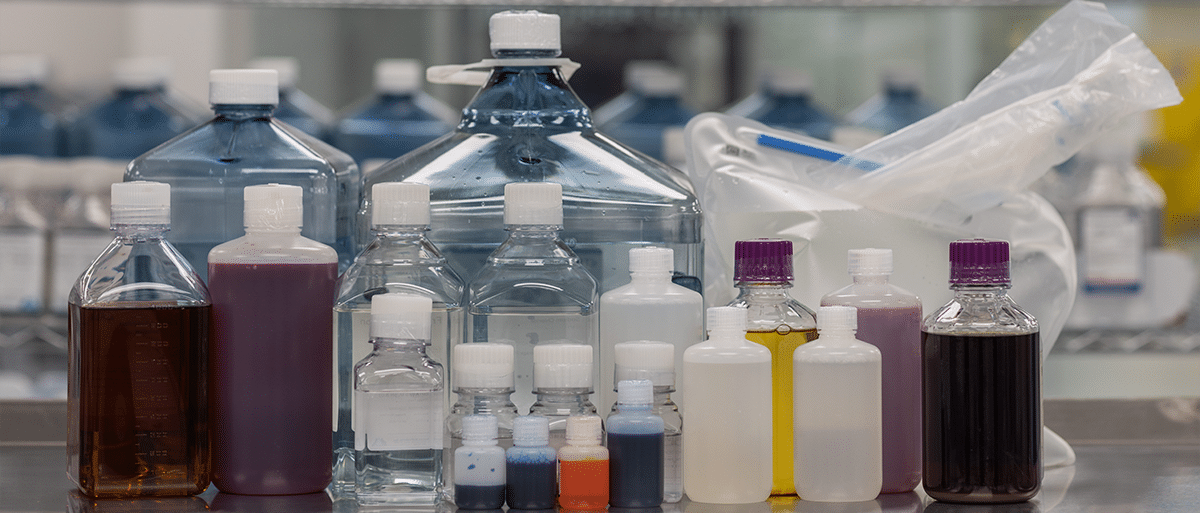
What Are Buffers and Solutions in Life Science?
Buffers are chemical systems that resist changes in pH, typically composed of a weak acid/base and its conjugate pair. Solutions, more broadly, include mixtures of salts, detergents, inhibitors, and other reagents designed to control biological and chemical environments.
Together, these systems are essential for:
- Maintaining physiological pH
- Supporting enzyme activity and protein stability
- Preserving cell viability
- Controlling ionic strength and osmotic balance
- Enabling reproducibility in assays and manufacturing
Types of Buffers and Solutions
Below are key solution categories used across life science workflows, along with their applications.
Major Buffer Systems
Major buffer systems are widely used across biological and biochemical workflows due to their defined pH ranges, stability, and compatibility with proteins and cells.
| Buffer System | Typical pH Range | Key Characteristics | Common Applications |
|---|---|---|---|
| Phosphate Buffers | 6.5 – 7.5 | High buffering capacity near physiological pH; widely compatible | Cell culture, washing, immunoassays |
| Tris Buffers | 7.0 – 9.0 | Temperature-sensitive pH; widely used in protein workflows | Electrophoresis, protein purification |
| Acetate Buffers | 3.6 – 5.6 | Effective in acidic conditions | Chromatography, protein purification |
| Borate Buffers | 8.0 – 10.0 | Strong buffering in alkaline range; interacts with diols | Carbohydrate analysis, electrophoresis |
| HEPES Buffers | 6.8 – 8.2 | Zwitterionic; minimal biological interference; stable in cell culture | Cell culture, live-cell imaging |
| Other Good’s Buffers (e.g., MOPS, MES) | 6.0 – 8.0 (varies) | Zwitterionic; Low metal binding, low UV absorbance, biologically inert | Enzyme assays, biochemical studies |
Cell Culture Media
Cell culture media provide essential nutrients, salts, buffering systems, and growth factors required to support cell survival, proliferation, and function. Different formulations are optimized for specific organisms, cell types, and experimental goals.
Types of Cell Culture Media
| Media Type | Examples | Key Components | Typical Applications |
|---|---|---|---|
| Basal Media (Mammalian) | DMEM, MEM, RPMI 1640 | Amino acids, vitamins, glucose, salts, buffering system | Routine mammalian cell culture, cancer cell lines, primary cells |
| Serum-Free Media | Serum-free DMEM variants | Defined nutrients, growth factors (no serum) | Controlled experiments, reproducibility, regulatory workflows |
| Microbial Growth Media | LB Broth, Terrific Broth, Tryptic Soy Broth (TSB) | Peptides, yeast extract, salts | Bacterial growth, plasmid prep, protein expression |
| Insect Cell Culture Media | Sf-900, Grace’s medium | Amino acids, lipids, vitamins | Baculovirus expression systems, insect cell propagation |
| Specialized Media | Hybridoma media, CHO media, stem cell media | Optimized nutrients + supplements | Antibody production, bioproduction, stem cell maintenance |
| Buffered Media Systems | Media with HEPES or bicarbonate | Buffering agents for pH stability | CO₂-independent culture, imaging workflows |
Acid and Base Solutions
Acidic and basic solutions are used to adjust pH, perform titrations, and support buffer preparation.
Balanced Salt Solutions
Balanced salt solutions maintain osmotic balance and provide essential ions for cells.
Metal Salt Solutions
Metal salt solutions supply ions critical for enzyme activity, conductivity, and osmotic balance.
Chelating Solutions
Chelators bind divalent metal ions and prevent unwanted enzymatic or chemical activity.
Antibiotic Solutions
Antibiotic solutions are widely used in cell culture and molecular biology workflows to prevent bacterial, fungal, and mycoplasma contamination.
Common Antibiotic Solutions and Applications
| Antibiotic Solution | Typical Components | Primary Use | Example Applications |
|---|---|---|---|
| Penicillin-Streptomycin (Pen-Strep) | Penicillin + Streptomycin | Broad-spectrum antibacterial | Routine mammalian cell culture, contamination prevention |
| Gentamicin | Gentamicin sulfate | Broad-spectrum antibiotic | Primary cell culture, microbial control in sensitive systems |
| Amphotericin B | Polyene antifungal | Antifungal protection | Prevent fungal contamination in long-term cultures |
| Antibiotic-Antimycotic (Anti-Anti) | Pen-Strep + Amphotericin B | Combined antibacterial + antifungal | Mixed protection for complex or high-risk cultures |
| Mycoplasma Control Reagents | Specialized antibiotic formulations | Mycoplasma prevention/removal | Critical cell culture workflows, QC environments |
Detergent Solutions
Detergents solubilize membranes and proteins for extraction and analysis.
| Detergent | Type | Application |
|---|---|---|
| Triton X-100 | Non-ionic | Cell lysis |
| SDS | Ionic | Protein denaturation |
| Tween-20 | Mild | Immunoassay washing |
Acrylamide Solutions
Used in gel electrophoresis for protein and nucleic acid separation.
| Solution | Application |
|---|---|
| Acrylamide/Bis | SDS-PAGE gels |
Sugar Solutions
Provide osmotic stabilization and cryoprotection.
Fixative Solutions
Preserve cellular structures for imaging and histology.
| Fixative | Application |
|---|---|
| Formaldehyde | Cell fixation |
| Paraformaldehyde | Immunohistochemistry |
Inhibitor Solutions
Prevent degradation of biomolecules.
| Inhibitor | Application |
|---|---|
| Protease inhibitors | Prevent protein degradation |
| Phosphatase inhibitors | Preserve phosphorylation |
Stains and Dyes
Used for visualization in biological assays.
| Stain | Application |
|---|---|
| Coomassie Blue | Protein staining |
| Trypan Blue | Cell viability |
How to Choose the Right Buffer or Solution
Selecting the right solution depends on several factors:
- pH requirements: Match buffer pKa to your target pH
- Biological compatibility: Ensure non-toxicity for cells or proteins
- Ionic strength: Critical for enzyme activity and stability
- Additives: Determine need for detergents, inhibitors, or chelators
- Application type: Cell culture, protein work, analytical assay, or bioprocessing
For example:
- Use PBS or balanced salts for washing cells
- Use HEPES or Tris buffers for protein stability
- Use detergent-containing buffers for lysis or membrane solubilization
Tips & Troubleshooting
Tips
- Always verify pH at working temperature
- Use sterile-filtered solutions for cell culture
- Match ionic strength to physiological conditions
- Use high-purity reagents for reproducibility
- Test compatibility when combining multiple components
Troubleshooting
| Issue | Possible Cause | Solution |
|---|---|---|
| pH drift | Temperature or dilution effects | Adjust pH after equilibration |
| Precipitation | Incompatible salts | Check solubility and mixing order |
| Poor cell viability | Incorrect osmolarity | Use isotonic solutions |
| Protein instability | Incorrect buffer choice | Switch to stabilizing buffer |
| Assay variability | Contamination or impurities | Use high-quality reagents |
Frequently Asked Questions (FAQs)
Summary
Buffers and solutions are foundational tools in life science research. Understanding their composition, function, and application context enables better experimental design, improved reproducibility, and more reliable results.
From core buffer systems to specialized reagents like detergents and inhibitors, selecting the right solution is key to optimizing workflows across cell biology, protein science, and bioprocessing.
Boston BioProducts Buffers and Solutions
- Browse pre-formulated buffers and solutions here
- Use our Custom Manufacturing / Reagent Builder to design buffers/solutions tailored to your specific needs