



What Are Buffer Solutions?
Buffer solutions are aqueous mixtures containing a weak acid and its conjugate base, or a weak base and its conjugate acid, which resist changes in pH when acids or bases are introduced. They are essential in biochemical workflows, ensuring that proteins, enzymes, cells, and analytical systems function within their required pH ranges.
A buffer solution maintains a stable pH by neutralizing added hydrogen or hydroxide ions, preventing rapid or unexpected changes.
For instance, an Acetate Buffer, composed of acetic acid and acetate ions, efficiently maintains pH stability for its related applications within the pH range of 3.8 to 5.8. The equation of an Acetate Buffer can be reviewed as seen below:
1 2 3 4
CH3COOH (aq) + H2O (l) ⇌ CH3COO- (aq) + H3O+ (aq)
Where:
Acetic acid (1), a weak acid, is combined with water (2), resulting in its deprotonation into a strong conjugate base known as an acetate ion (3), and a subsequent hydronium ion (4).
This aqueous solution is effective at regulating the pH of an environment from a pH of 3.6 to 5.6, as the pKa value (the negative logarithm of the dissociation constant) for acetic acid is 4.6.
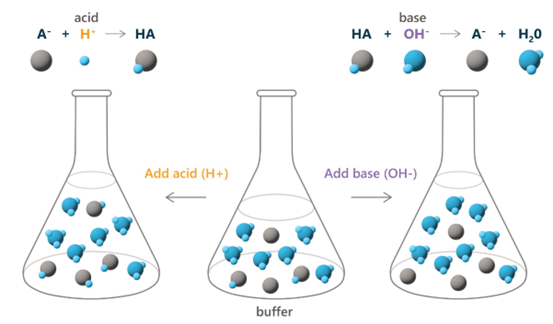
Buffer action: conjugate acid–base pair maintaining stable pH upon addition of H⁺ or OH⁻
What Is pH Optimization?
pH optimization refers to selecting the right buffer system, pH value, concentration, ionic strength, and temperature conditions to maintain the environment your biological system requires.
Proper pH control ensures stable reaction kinetics, enzyme activity, protein folding, and cell viability.
The process of optimizing pH involves:
- Choosing a buffer with a pKa within ±1 of the desired pH
- Considering assay temperature and ionic strength
- Ensuring reagent compatibility with metals, proteins, and cells
- Monitoring pH stability throughout the experiment
How Do Buffers Maintain pH?
Buffers stabilize pH by using an equilibrium between a weak acid (HA) and its conjugate base (A–):
HA ⇌ H⁺ + A⁻
When acids or bases are added:
- Added H⁺ is absorbed by A⁻, forming more HA
- Added OH⁻ is neutralized by HA, forming water and A⁻
This prevents sudden shifts in pH, keeping biological systems stable.
How to Choose the Right Buffer Solution
When selecting a buffer, consider:
- Target pH & Buffer pKa
Choose a buffer whose pKa is within one unit of your target pH.
Examples:
-
- MES (pKa 6.1) for near-neutral biochemical assays
-
- Tris (pKa 8.1) for protein extraction or DNA workflows
- Tris (pKa 8.1) for protein extraction or DNA workflows
- Temperature Effects
Buffers like Tris shift pH significantly with temperature.
If your workflow involves heating/cooling steps, choose a temperature-stable buffer system.
- Ionic Strength & Concentration
Buffers with high ionic strength may affect:
-
- Enzyme kinetics
-
- Electrochemical measurements
-
- Cell culture media compatibility
- Metal Ion Binding & Interference
Some buffers (e.g., citrate) chelate metal ions and may:
-
- Inhibit metalloproteins
-
- Alter enzyme reactions
-
- Destabilize certain cofactors
- Compatibility With Assays & Detection Systems
Some buffers absorb strongly at UV-visible wavelengths or interfere with colorimetric assays. Choose buffers that do not overlap with your detection method.
Find the Ideal Buffer for Optimal pH Maintenance
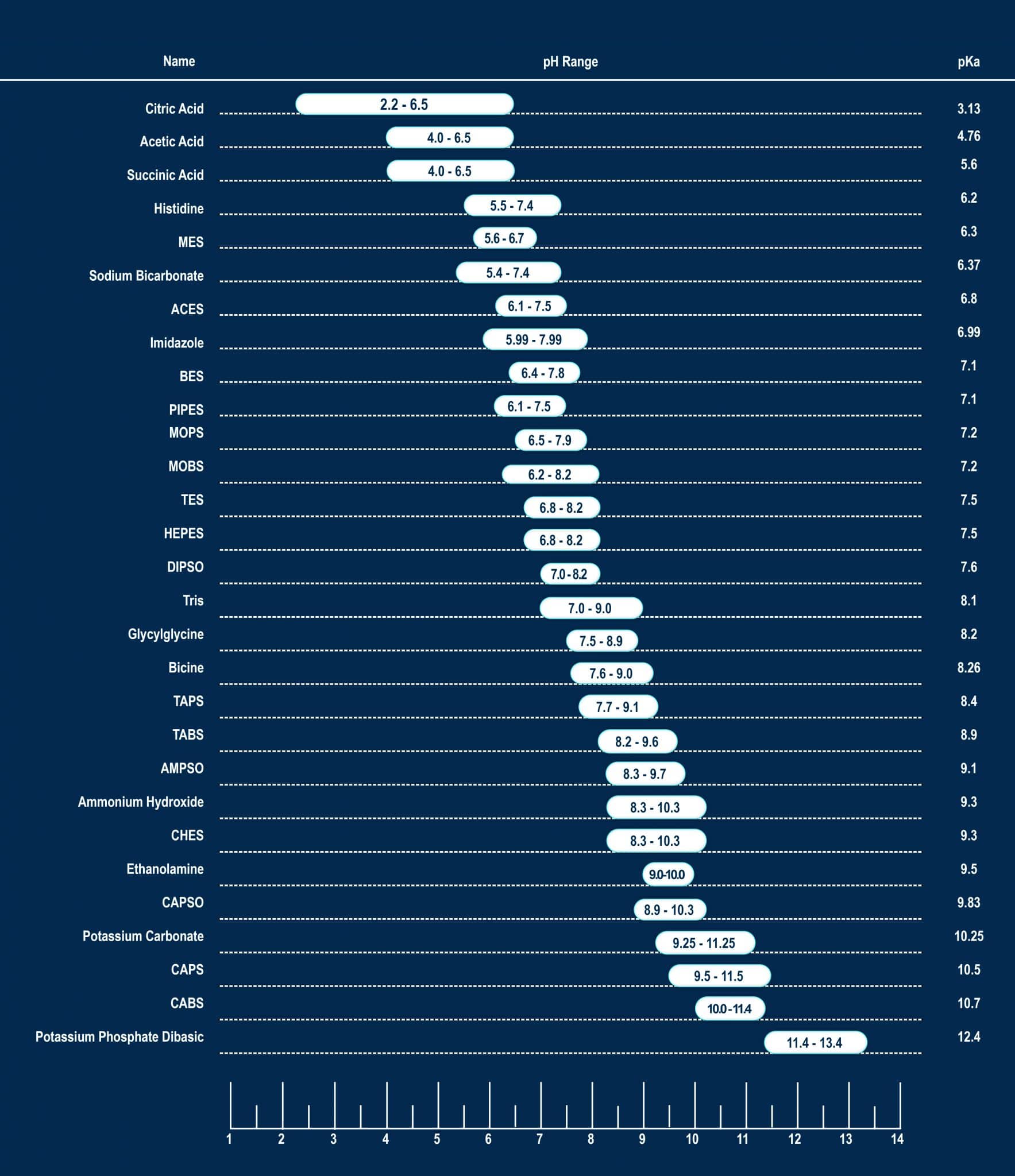
Applications of Buffer Solutions
| Application | Preferred Buffer Systems | Notes |
|---|---|---|
| Enzyme assays | HEPES, MOPS, Tris | Maintain narrow pH ranges required for activity. |
| Protein purification | PBS, Tris, citrate buffers | Supports protein solubility and stability. |
| Cell culture | HEPES-based buffers | Minimize pH drift in CO₂-independent workflows. |
| Chromatography | Phosphate, citrate buffers | Stable across flow rates and temperatures. |
| Electrophoresis | Tris-glycine, Tris-borate | Maintain pH across applied voltages. |
Every buffer is unique to its intended application. Experience thousands of different buffer combinations and select the one that matches your exact requirements in terms of pH, concentration, and conductivity by exploring custom manufacturing options at Boston BioProducts, or our catalog buffers.
Tips & Troubleshooting
Tips
- Calibrate pH meters with NIST-traceable standards before preparing buffers.
- Adjust pH at working temperature, not room temperature.
- Avoid using strong acids or bases to make large pH adjustments—this disrupts buffer capacity.
- Use sterile, filtered water for biological applications.
- For cell culture, select buffers with minimal cytotoxicity and low temperature sensitivity (e.g., HEPES).
Troubleshooting Guide
| Issue | Likely Cause | Recommended Fix |
|---|---|---|
| pH drifts during the experiment | Temperature changes or insufficient buffer capacity | Re-adjust at working temperature; increase buffer concentration. |
| Enzyme activity decreases | Buffer incompatible with metal cofactors | Switch to non-chelating buffers (e.g., HEPES, MOPS). |
| Precipitation forms | Salt concentration too high or incompatible ions | Reduce ionic strength; verify chemical compatibility. |
| pH meter inconsistencies | Dirty electrode or expired standards | Clean electrode; replace calibration solutions. |
| Buffer absorbs at detection wavelengths | UV-absorbing buffer (e.g., Tris, imidazole) | Switch to low-absorbance buffers like HEPES or phosphate. |
Frequently Asked Questions (FAQs)
Buffers at Boston BioProducts
Buffer solutions are essential tools for maintaining stable pH in biological and analytical workflows. By understanding how buffers work and how to choose the right one based on pKa, temperature effects, ionic strength, and assay compatibility, researchers can improve reproducibility, accuracy, and experimental performance.
Experience hundreds of different buffer combinations and select the one that matches your exact requirements in terms of pH, concentration, and conductivity by exploring custom manufacturing options at Boston BioProducts, or our catalog buffers.