



Overview: Electrophoresis Buffers
Gel electrophoresis is a foundational laboratory technique used to separate biomolecules (DNA, RNA, proteins)[1-3], based on differences in size, charge, and shape. It is widely used in molecular biology and biochemistry for applications such as analyzing nucleic acids, characterizing proteins, detecting mutations or post-translational modifications, and more.
In a typical workflow, a porous gel (agarose or polyacrylamide) is cast in a buffer, samples are prepared with loading buffers, and an electric field is applied to drive migration through the gel. Smaller or more highly charged molecules generally migrate faster than larger or less charged species.
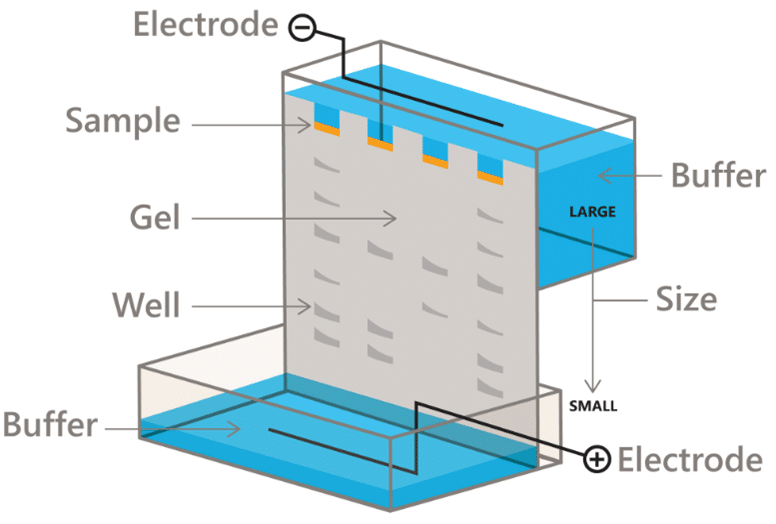
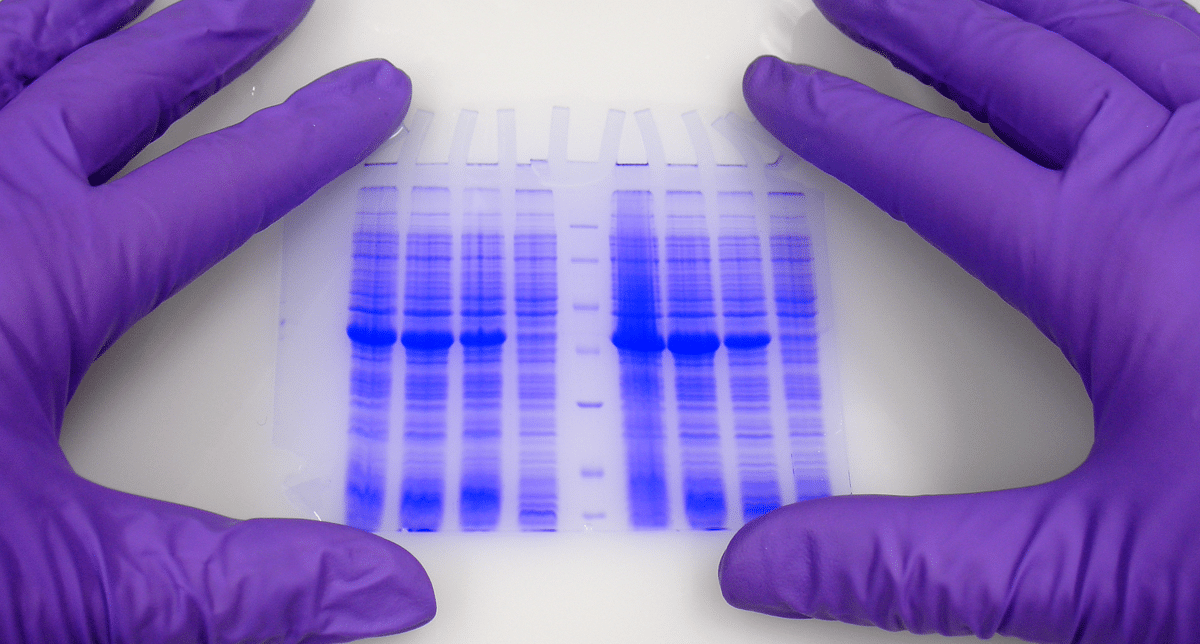
Image 1: Polyacrylamide gel electrophoresis (PAGE) is one example of gel electrophoresis that can be used to separate protein samples. Not to be confused with agarose gel electrophoresis, PAGE is presented in a vertical gel, where results can be visualized.
What is an Electrophoresis Buffer?
An electrophoresis buffer is a solution that provides:
- Ionic strength and conductivity, allowing current flow through the gel environment.
- pH control / buffering capacity, ensuring stable pH during migration so that the molecules retain predictable charge states.
- Compatibility with the molecules of interest, not interfering with the biomolecules or gel chemistry.
In electrophoresis workflows, multiple types of buffers are used at different stages (casting, running, transfer, etc.), each optimized for its role.
Common Electrophoresis Buffer Types & Their Roles
Below is a table summarizing the main buffer classes in electrophoresis and what they are used for:
| Buffer Type | Purpose / Role | Typical Components & Notes |
|---|---|---|
| Gel Casting Buffer | To prepare the gel matrix (agarose or polyacrylamide) | Contains the buffering ions (e.g. TAE or TBE for agarose, Tris-HCl for PAGE) and provides stable pH and ionic environment during polymerization and later migration |
| Sample / Loading Buffer | To prepare the biomolecule sample before loading | May include denaturants (e.g. SDS), reducing agents (e.g. DTT or β-mercaptoethanol), tracking dyes (e.g. bromophenol blue), glycerol or other density agent to help loading |
| Running / Electrophoresis Buffer | To fill the tank / chamber and ensure conduction during migration | Usually, the same or closely matched buffer system as the gel (to avoid pH/ionic discontinuities) |
| Transfer Buffer | To move molecules from gel into membranes (blotting) | For proteins: often Tris-Glycine (plus methanol). For nucleic acids: Tris-Borate, or other suitable buffer systems. Methanol (10–20%) may be added to assist binding of proteins to membrane |
| Blocking Buffer | To block nonspecific binding sites on a membrane after transfer | Contains a protein (e.g. BSA, non-fat dry milk) or other blocking agent to reduce background in immunodetection |
| Stripping Buffer | To remove primary/secondary antibodies from the membrane for reprobing | Often low pH (e.g. glycine-HCl) to disrupt antibody–antigen binding |
In practice, which buffer formulations you use depends on the analyte (DNA, RNA, protein) and the downstream detection or processing steps.
Applications of Electrophoresis Buffers
Electrophoresis buffers enable a wide range of common laboratory techniques, including:
- DNA / RNA electrophoresis & Southern / Northern blotting: using agarose gels and buffer systems like TAE, TBE, Tris-Borate, etc.
- Protein separation (PAGE / SDS-PAGE): electrophoresis of proteins before transfer to membranes for Western blotting or mass spectrometry.
- Protein blotting (Western or Eastern blotting): buffer systems designed for optimal transfer of proteins from gel to membrane.
- Nucleic acid transfer / blotting (Southern, Northern): buffer systems for transfer of DNA or RNA onto membranes for probe hybridization.
- Membrane immunoassays / immunodetection workflows: e.g. after transfer, using blocking buffers and antibody incubation steps.
Because buffers are integral to each step, choosing the right buffer, or customizing one, is critical to ensure clean separation, minimal artifacts, and compatibility with downstream detection.
Boston BioProducts offers both off-the-shelf electrophoresis buffers and the option for custom buffer formulation / manufacturing to meet specific experimental needs.
Practical Tips & Best Practices
- Match buffer systems: Use the same ionic system (or very compatible ones) for gel casting and running buffers to maintain steady pH and field strength.
- Maintain pH stability: Changes in pH can alter molecule charge states, migration behavior, and resolution quality.
- Fresh reagents — Reducing agents, dyes, or other labile components degrade over time. Use freshly prepared or aliquoted solutions.
- Avoid salt overloads / interfering substances — High salt or incompatible additives in your sample will distort fields or cause smearing.
- Optimize buffer concentration / strength — Too low ionic strength leads to poor conductivity and slow runs; too high can lead to excessive heat or distortion.
- Temperature control / cooling — For long electrophoreses, overheating can degrade resolution; use cooling or lower voltage if needed.
- Methanol / additives in transfer buffer — In protein transfer, methanol helps binding to membrane but may reduce gel porosity; balance accordingly.
- Blocking and stripping — After transfer, ensure blocking buffer covers all nonspecific sites, and for reprobing, stripping buffer should be gentle but effective.
Frequently Asked Questions (FAQs)
References:
- Aaij, C., & Borst, P. (1972). The gel electrophoresis of DNA. The gel electrophoresis of DNA - ScienceDirect
- Petrov, A., Tsa, A., & Puglisi, J. D. (2013). Analysis of RNA by analytical polyacrylamide gel electrophoresis. In J. N. Abelson, M. I. Simon, & D. W. Moskowitz (Eds.), Methods in enzymology (Vol. 530, pp. 301-313). Analysis of RNA by Analytical Polyacrylamide Gel Electrophoresis - ScienceDirect
- Hames, B. D. (Ed.). (1998). Gel electrophoresis of proteins: A practical approach(3rd ed.).