


Overview: Acid and Base Solutions
Acid and base solutions are fundamental reagents used to control pH, drive chemical reactions, and maintain optimal conditions in biological, chemical, and analytical workflows. In laboratory environments, they are routinely applied for pH adjustment, buffer preparation, titrations, sample processing, and process-scale manufacturing.
Understanding how acids and bases behave in solution, and how their strength and concentration affect biological system, helps ensure reproducibility, experimental accuracy, and system stability.
What Are Acid and Base Solutions?
Acid and base solutions are aqueous formulations that either donate protons (H⁺) or accept protons (or generate OH⁻ ions) when dissolved in water.
- Acidic solutions lower pH by increasing hydrogen ion concentration
- Basic (alkaline) solutions raise pH by increasing hydroxide ion concentration
These solutions are used alone or in combination with buffers to fine-tune pH and ionic conditions across a wide range of laboratory workflows.
How Do Acids and Bases Work in Solution?
Strong vs. Weak Acids and Bases
Acids and bases are classified by the extent to which they dissociate in water:
- Strong acids/bases fully dissociate
- Examples: hydrochloric acid (HCl), sodium hydroxide (NaOH)
- Weak acids/bases partially dissociate
- Examples: acetic acid, ammonium hydroxide
This distinction matters because strong reagents cause rapid pH changes, while weak systems allow more controlled adjustments.
Neutralization Reactions
When an acid and a base react, they form:
- A salt
- Water
These reactions are commonly used in:
- Titrations
- Buffer preparation
- Process neutralization steps
In biological systems, maintaining controlled neutralization is critical to avoid protein denaturation or loss of enzymatic activity.
Examples of Acidic and Basic Solutions
Solution Type |
Acid or Base |
Common Laboratory Uses |
|---|---|---|
| Hydrochloric Acid (HCl) Solution | Strong acid | pH adjustment, titrations, protein denaturation studies |
| Acetic Acid Solution | Weak acid | Buffer preparation, chromatography, biochemical assays |
| Phosphoric Acid Solutions | Weak/moderate acid | Buffer systems, biochemical processing |
| Sodium Hydroxide (NaOH) Solution | Strong base | pH correction, neutralization, cleaning protocols |
| Potassium Hydroxide (KOH) Solution | Strong base | Chemical synthesis, analytical workflows |
| Borate, carbonate, phosphate systems | Weak base systems | Buffering and pH stabilization |
These examples also create natural entry points for buffer systems, such as acetate, borate, carbonate, and phosphate buffers.
How to Choose the Right Acid or Base Solution
- Define your goal
- Rapid pH correction to strong acid/base
- Controlled pH adjustment to weak acid/base or buffered system
- Consider biological compatibility
- Extreme pH can denature proteins or inhibit enzymes
- Gradual pH control is preferred for cell-based and enzymatic assays
- Evaluate concentration and strength
- Higher molarity = stronger pH impact and higher safety considerations
- Check downstream effects
- Salt formation during neutralization
- Ionic strength changes
- Potential assay interference
- Match reagent to workflow scale
- Analytical bench work vs. process-scale applications
Application Context & Key Use-Cases
| Application | Role of Acid/Base Solutions | Key Considerations |
|---|---|---|
| pH adjustment & buffer prep | Fine-tuning final pH | Add slowly; verify pH at working temperature |
| Enzyme & protein assays | Maintaining activity range | Avoid rapid pH swings |
| Titrations | Quantitative analysis | Use standardized concentrations |
| Cell culture media prep | pH correction | Prevent osmotic or ionic stress |
| Bioprocessing | Neutralization & cleaning | Consistency, documentation, scalability |
Tips & Troubleshooting
Best Practices
- Always add acid or base slowly with mixing to avoid localized pH extremes
- Measure pH after temperature equilibration
- Use calibrated pH meters and fresh electrodes
- Store solutions properly to prevent concentration drift
Acid and Base Solutions at Boston BioProducts
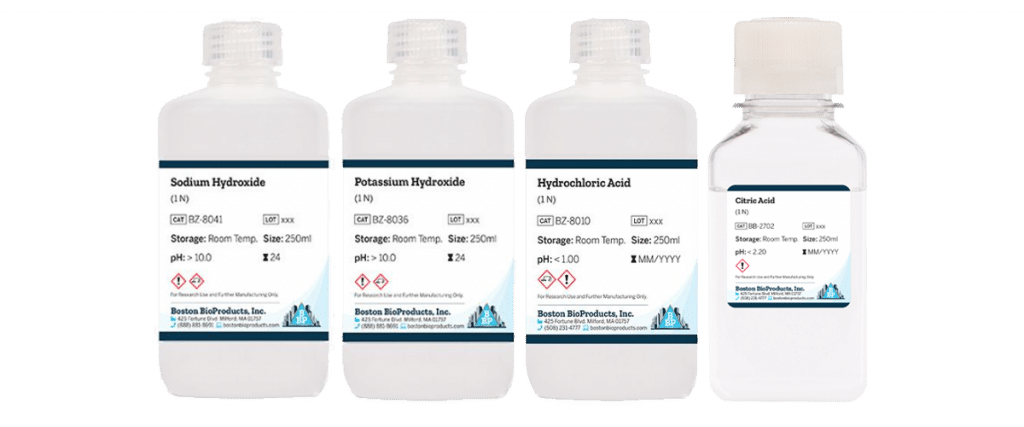
Every Acid or Base Solution is unique to its intended application. Selecting the correct reagent strength, concentration, and application method ensures reproducibility, safety, and optimal performance across laboratory and process environments. Experience a variety of acid and base solution types, and choose the correct one for your workflows in terms of ionic species, pH requirements and concentration by exploring custom manufacturing options at Boston BioProducts, or our off-the-shelf Acid & Base Solution products.